Transcribing 20th century Surinamese death certificates using Transkribus and GPT
.webp)
About the HDSC
The Historical Database of Suriname and the Caribbean (HDSC) is dedicated to making historical documents such as slave registers and civil status records available online. This makes it possible to reconstruct life histories of individuals, especially around major transitions such as the abolition of slavery in 1863. Thanks to volunteers and sponsors, the slave registers of Suriname have been viewable online since 2018, followed by those from Curaçao in 2020. Since 2023, the birth certificates of Paramaribo have also become searchable online via the website of the National Archive of Suriname. More civil status records from Suriname and the former Dutch Caribbean are currently being transcribed.
Project
In this project, we adapted our HTR+GPT pipeline to process 40,000 twentieth-century Surinamese death certificates. With the help of 10 dedicated volunteers, we transcribed 500 scans in Transkribus. These transcriptions were used as training data for two custom Field models, a Baseline model, and an HTR model.
We also developed a Python script to reduce Transkribus costs. For the first half of the certificates, field detection (costing one credit per scan) became unnecessary. Baseline detection with automatic region detection at 0.25 credit per scan was sufficient for most records. For a smaller subset of scans containing marginalia text, baseline detection failed. Our Python code estimated the average position where the main certificate text starts and used that to split overlapping baselines between the marginalia and the certificate text. This successfully adjusted 668 of 20,000 scans and saved 20,000 Transkribus credits.
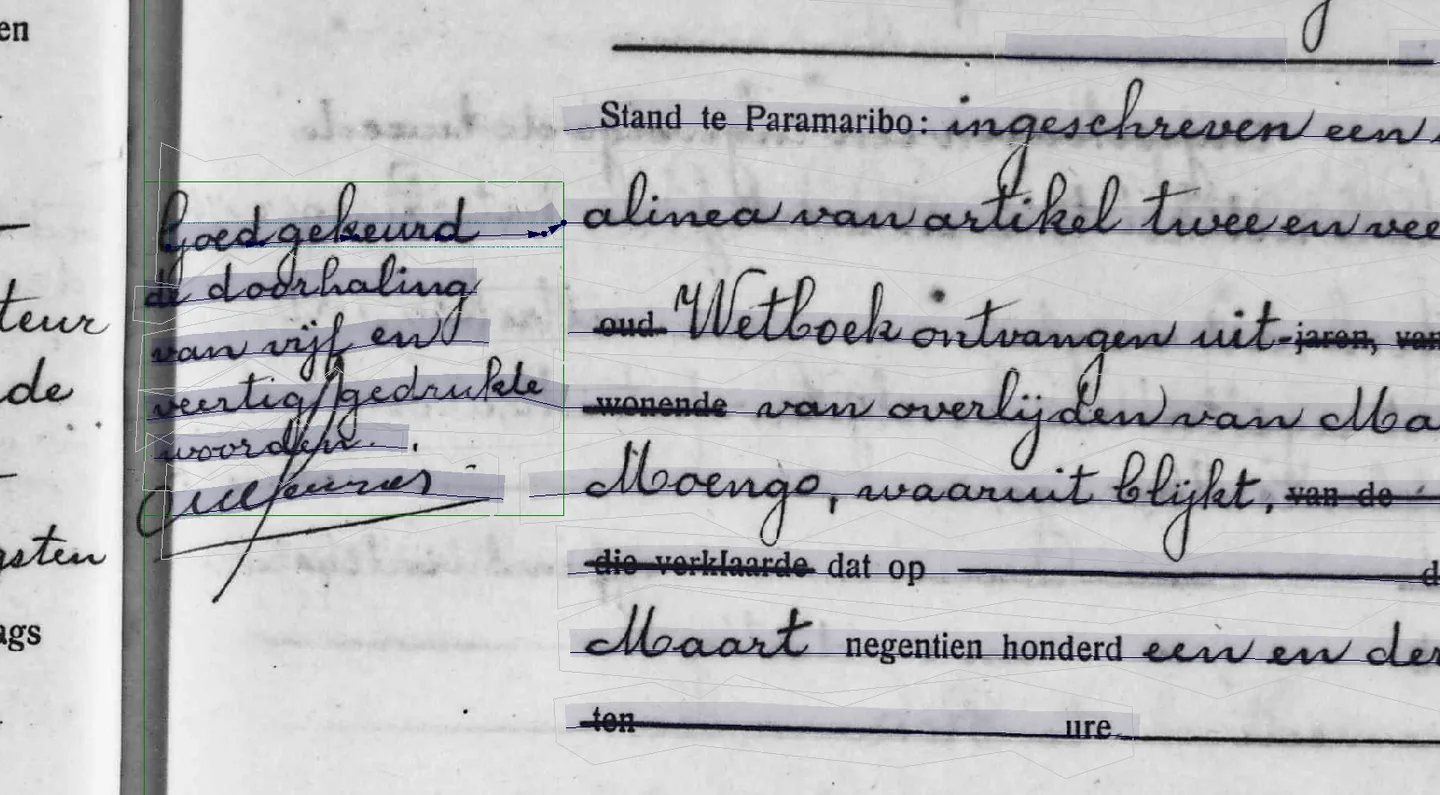
We observed that HTR quality was higher than for the Curaçaoan certificates, likely due to easier handwriting and better scan quality. The HTR training achieved a Character Error Rate (CER) of 2.97% on the validation set, though this was largely influenced by the printed certificate text, which is relatively easy to read. Handwritten text remains more difficult. In the Curaçaoan material, for example, names of the deceased had a CER of 10%. To ensure final quality, all extracted entities are still checked by volunteers in a review project.
For entity extraction, we tested OpenAI’s GPT-4o and obtained satisfactory results. Performance was similar to GPT-4, but with lower processing costs. After several prompt iterations, GPT-4o was run over all 20,000 HTR-processed transcriptions. Colleagues then split and standardized names for the first half of the dataset. For the second half, only standardization was required, because GPT was able to split names into first and last names automatically.
We do not yet have a final evaluation of the extraction performance. The resulting entities are now being corrected by volunteers in a review project to ensure quality. We expect performance to be higher than for the Curaçaoan material because of the better scan quality, easier handwriting, larger training dataset, and newer GPT model. For the Curaçaoan evaluation, we refer to the previous project.